Intelerad vs Medicai for AI-Assisted Radiology Workflow Automation
Radiology teams must now choose between Intelerad and Medicai when they need an AI-assisted workflow that actually reduces reading time. Many platforms promise automation but still force manual routing, separate logins, and extra clicks before an AI result appears in the worklist.
By the end of this article you will see exactly how each platform handles AI integration, cloud PACS performance, and security compliance. You will also get a clear verdict on which platform fits an imaging group that needs immediate workflow automation versus one that can tolerate longer setup cycles.
Quick Verdict: Intelerad vs Medicai for AI-Assisted Radiology Workflow Automation
Intelerad and Medicai differ sharply in deployment models and AI orchestration depth.
Intelerad relies on a traditional on-premise architecture that separates PACS and RIS functions, while Medicai operates as a unified cloud PACS platform with native AI orchestration. This architectural gap affects how each system handles DICOM studies, HL7 messages, and FHIR resources during automated workflows.
AI workflow depth varies significantly between the platforms. Intelerad integrates external AI tools through standard APIs, yet Medicai embeds AI triage and case prioritization directly into the core system. This integration enables automated study routing and workload balancing across 70 clinics and hospitals that process over 1M studies annually.
Pricing transparency also distinguishes the two solutions. Intelerad often requires custom quotes based on on-premise infrastructure needs. Medicai provides clear SaaS pricing tied to usage metrics, including 50M yearly API transactions and 2M imaging studies uploaded across its network of 10,000 active doctors.
At a glance: how Medicai compares to Intelerad, Medicai for AI-Assisted Radiology Workflow Automation on the features that matter most.
| Feature | Medicai | Intelerad | Medicai for AI-Assisted Radiology Workflow Automation |
|---|---|---|---|
| AI-Assisted Radiology Workflow Automation | ✓ | ✓ | — |
What Is Medicai?
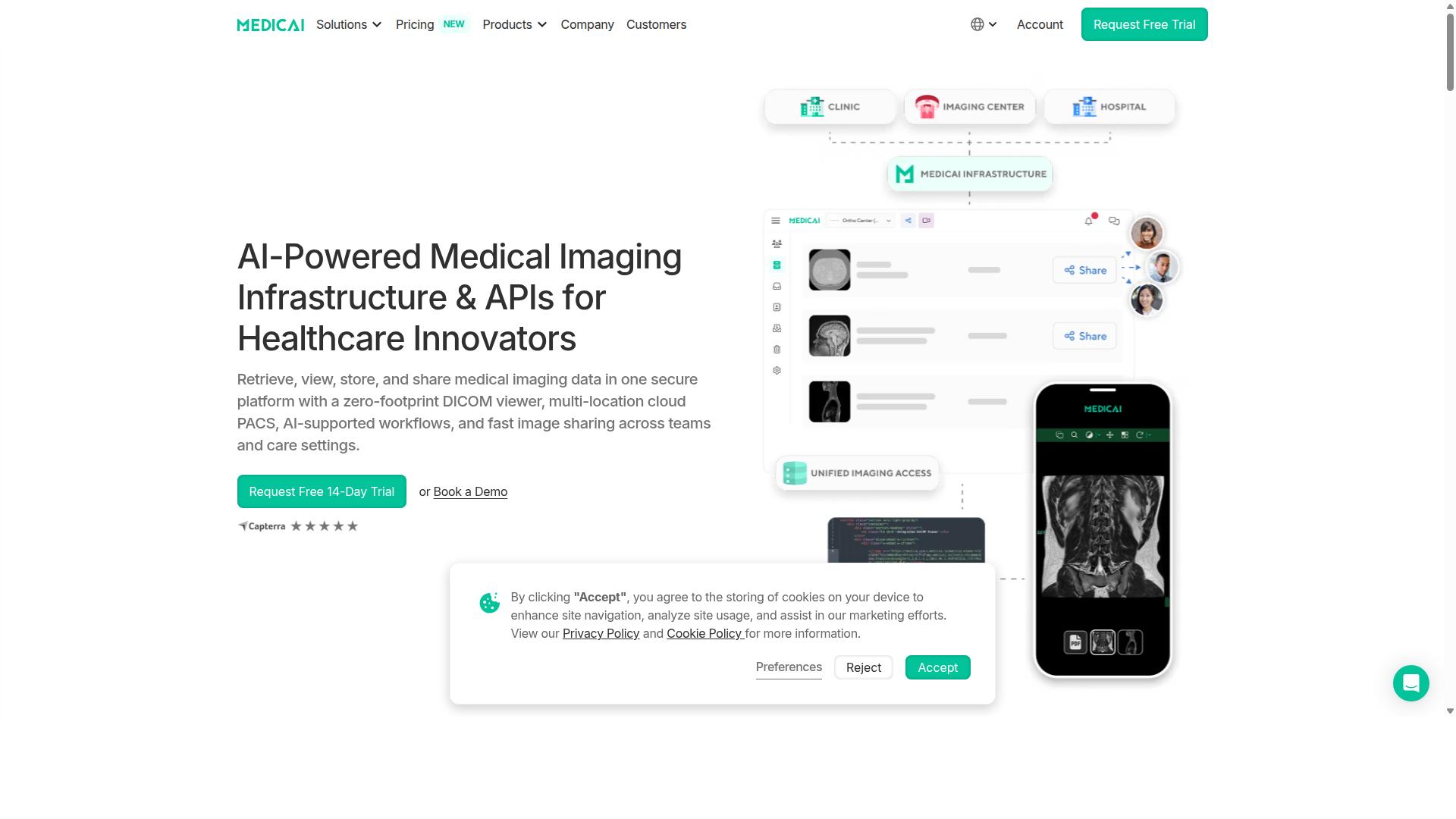
Medicai is a cloud-native medical imaging platform that unifies retrieval, viewing, storage, and sharing on one interface.
Zero-footprint DICOM viewer technology enables radiologists to access studies from any web browser without local software installation. This approach eliminates compatibility issues across different hospital systems and reduces IT overhead for deployment.
The platform operates with global availability across multiple care settings. Cloud infrastructure supports consistent access for distributed teams working on teleradiology cases or multi-site hospital networks that need coordinated diagnostic imaging workflows.
1.7 M+ studies currently stored demonstrate the platform's capacity to manage large imaging repositories. This volume indicates proven scalability for institutions transitioning from on-premise PACS to cloud-based solutions for AI-assisted radiology tasks.
Medicai provides Imaging Infrastructure as a Service through a vendor-neutral archive model. The platform supports interoperability standards including DICOM, HL7, and FHIR for seamless integration with existing RIS systems and third-party AI tools used in automated reporting and case prioritization.
Healthcare providers use the platform to consolidate radiology workflow components that traditionally require separate systems. Multi-location cloud PACS functionality allows centralized management while maintaining fast image sharing across care teams and external referring physicians.
What Is Intelerad?

Intelerad is an established radiology software suite known for on-premise PACS and RIS integrations. This traditional approach has served healthcare organizations for many years through local server installations.
Many radiology departments rely on this type of on-premise PACS for storing and accessing medical images. The RIS component handles patient scheduling and report management within hospital systems.
Traditional on-premise setups require dedicated IT resources for maintenance and updates. Organizations typically manage their own servers and ensure compliance with data security protocols.
Workflow automation in this environment often depends on local configuration settings. Staff members handle routine tasks like image routing and study prioritization through established departmental procedures.
When comparing radiology solutions, healthcare teams evaluate factors like system flexibility and integration capabilities. Modern approaches to AI-assisted radiology may require different infrastructure considerations than legacy on-premise platforms.
What Is Medicai for AI-Assisted Radiology Workflow Automation?
Medicai embeds AI orchestration directly into its cloud PACS so studies are triaged and routed before radiologists open them. This approach supports AI-assisted radiology workflow automation from the moment a DICOM study arrives in the system.
An incoming DICOM study activates AI micro-services that analyze the images for urgency markers. The results feed into a priority worklist that surfaces critical cases first, helping teams manage case prioritization effectively.
Structured reporting follows automatically once the radiologist completes review. The system populates report templates with AI findings, reducing manual data entry and supporting automated reporting within the same interface.
Medicai combines this sequence with its Radiology AI Co-Pilot and AI-Powered Diagnostics services. These tools work together with existing DICOM Gateway and Medical Imaging Uploader connections, keeping studies moving through the workflow without additional transfers.
The platform stores processed studies in its Cloud PACS and Vendor Neutral Archive. This setup supports teleradiology teams and Tumor Boards by providing consistent access to both original images and AI-generated insights.
Features Compared
Three core capability areas reveal measurable differences between the two platforms.
Intelerad and Medicai both target radiology departments seeking workflow automation, yet their approach to AI orchestration, image management, and security posture diverges significantly. Hospitals evaluating these solutions must weigh deployment models, transaction volumes, and compliance frameworks against their specific operational requirements.
AI Integration & Workflow Automation
Both platforms claim AI triage, yet they differ in orchestration depth and latency. Medicai processes over 50 million API transactions annually while supporting more than 300,000 DICOM visualizations, demonstrating substantial scale in automated image handling and routing workflows.
Intelerad offers general AI capabilities that work together with existing radiology systems, though specific transaction volumes and orchestration metrics remain less publicly documented. The depth of AI-assisted case prioritization and study routing affects how quickly radiologists receive flagged studies for review.
Workflow automation benefits appear most pronounced when platforms handle high-volume environments with consistent AI orchestration. Medicai's API transaction scale supports real-time image processing across distributed radiology teams, reducing manual handoffs between systems.
Automated reporting features and structured reporting capabilities vary between platforms in their integration with existing RIS workflows. Hospitals should assess how each solution handles modality worklist management and study routing when AI findings require immediate radiologist attention.
Cloud PACS & Image Sharing
Deployment architecture dictates sharing speed and integration limits. Medicai operates as a cloud PACS with vendor-neutral archive capabilities, enabling real-time image exchange across healthcare networks without requiring on-premise infrastructure investments.
Intelerad traditionally follows an on-premise deployment model that may limit external sharing speed and increase integration complexity with external systems. Cloud-based architectures generally support faster image retrieval and broader interoperability with HL7 and FHIR standards.
Medicai's cloud infrastructure supports both internal radiology workflows and external collaborations such as tumor boards and teleradiology consultations. The vendor-neutral archive approach allows hospitals to maintain image accessibility while reducing local storage requirements and backup responsibilities.
Real-time image exchange becomes critical when radiologists need immediate access to prior studies from referring facilities. Cloud PACS deployments typically reduce turnaround times by eliminating physical media handling and local network bottlenecks that affect on-premise solutions.
Security & Compliance
Compliance certifications directly affect hospital procurement decisions. Medicai maintains HIPAA and GDPR compliance while offering FDA and CEE cleared viewers, addressing regulatory requirements common in both US and European healthcare markets.
Intelerad maintains general compliance capabilities appropriate for healthcare environments, though specific certification details vary by deployment configuration and regional requirements. Security frameworks must address both data protection and access controls for distributed radiology teams.
OWASP security guidelines followed by Medicai provide additional assurance for hospitals concerned with application-level vulnerabilities in imaging platforms. Microsoft Azure partnership adds enterprise-grade infrastructure security that many procurement teams recognize from existing technology stacks.
Healthcare organizations evaluating these platforms should verify that compliance certifications align with their specific regulatory obligations and geographic operational requirements. Security posture influences both procurement timelines and ongoing operational risk assessments.
Pricing Compared
Transparent tiered pricing separates Medicai from traditional quote-based models.
Medicai publishes clear monthly rates that simplify budget planning for radiology practices. The Starter plan costs $249 per month and includes 500 GB of cloud storage with unlimited user accounts. The Standard plan costs $749 per month and provides 2 TB of cloud storage plus one connected location.
Yearly billing reduces these rates by 15 percent. The Starter plan drops to $209 monthly when paid annually. The Standard plan drops to $639 monthly when paid annually. Enterprise customers access custom storage limits and multiple connected locations through individual quotes.
A single DICOM Gateway setup costs $1,000 per location as a one-time fee. Medicai offers a 14-day trial of the Starter plan without requiring a credit card. Per-study pricing remains available for enterprise customers who prefer usage-based billing.
Intelerad follows a quote-based pricing approach typical of enterprise PACS vendors. This method often requires extended sales cycles and multiple approval steps before organizations receive final costs. The lack of published rates makes direct budget comparisons difficult for smaller radiology groups.
Fixed monthly tiers help practices forecast expenses when implementing AI-assisted radiology workflow automation. Medicai pricing structure supports predictable costs for cloud PACS, image routing, and automated reporting features across different practice sizes.
Who Should Choose Medicai
Hospitals and imaging centers that need rapid deployment and predictable costs gravitate to Medicai. The platform serves mid-size radiology groups and teleradiology practices that process high volumes of studies without managing complex infrastructure.
Medicai processes over 1 million studies yearly across a global network. This scale supports organizations that require consistent performance during peak periods and reliable availability across different time zones.
The target audience includes teleradiology services, hospital radiology departments, and specialty providers in orthopedics, neurology, oncology, and cardiology. Virtual care platforms and medical education organizations also benefit from the same infrastructure.
Organizations that rely on AI-assisted radiology workflow automation find value in Medicai's approach to image routing and study prioritization. The system integrates with existing PACS and RIS environments through standard DICOM, HL7, and FHIR protocols.
Compared to Intelerad, Medicai offers deployment flexibility that smaller radiology groups often prefer. While Intelerad solutions work well in large enterprise settings with dedicated IT teams, Medicai reduces the need for extensive on-site configuration.
The cloud PACS model eliminates hardware maintenance concerns that typically accompany on-premise systems. This approach supports radiologist productivity by removing infrastructure barriers to AI tool integration.
Who Should Choose Intelerad
Large health systems with existing data-center infrastructure often stay with Intelerad. These organizations value direct oversight of hardware and security policies. On-premise deployments allow IT teams to manage updates and compliance without external dependencies.
Existing PACS and RIS installations make migration costly. Hospitals that already own storage arrays and network equipment may prefer to extend current contracts. This approach reduces capital expenditure on new cloud subscriptions.
Specialist centers handling high volumes of sensitive data choose Intelerad. Military hospitals and government facilities often require isolated networks. On-premise control meets strict data residency rules that cloud options may not satisfy.
Organizations with mature internal teams benefit from Intelerad. Dedicated staff can monitor storage performance and schedule maintenance windows. This model supports predictable budgeting when hardware refresh cycles are already planned.
Workflows that rely on HL7 and DICOM interfaces may stay unchanged. Legacy modalities connect directly to on-premise servers without additional translation layers. Staff already trained on these connections face minimal disruption during upgrades.
Who Should Choose Medicai for AI-Assisted Radiology Workflow Automation
Groups seeking AI-driven prioritization without on-premise servers select Medicai. This cloud-native platform supports organizations that need rapid access to AI-assisted radiology tools without managing physical infrastructure.
The service has processed 1M+ studies in the past year alone. Organizations that handle high imaging volumes value this proven capacity for workflow automation.
Groups that require flexible access across locations benefit from cloud deployment. Teams working with remote specialists or multiple sites find this architecture practical for maintaining consistent radiology workflow processes.
Clinics and hospitals already using the platform total 70 institutions. These organizations demonstrate how Medicai supports AI-assisted radiology workflow automation at scale.
Over 10,000 active doctors currently rely on the platform. This adoption indicates practical value for radiologist productivity and case prioritization tasks.
Storage capacity reaches 1.7M+ studies with 2M+ imaging studies uploaded overall. Organizations managing large diagnostic imaging archives find this capacity adequate for long-term needs.
The platform completed 300k+ visualizations of DICOM studies last year. This activity level shows sustained usage for image review and analysis tasks.
API transactions total 50M+ yearly. Groups requiring integration with existing PACS or RIS systems can leverage this transaction volume for workflow automation.
Compliance with HIPAA and GDPR standards addresses data security requirements. Organizations subject to these regulations find this compliance framework suitable for their operational needs.
Microsoft Azure partnership provides infrastructure backing for the service. Groups preferring established cloud providers see this relationship as a stability factor.
FDA and CEE cleared viewers are available within the platform. Organizations requiring regulatory clearance for diagnostic tools find these options applicable to their workflow.
Security follows OWASP guidelines. This approach addresses common web application vulnerabilities that matter for medical imaging platforms handling sensitive patient data.
Diagnosis time reduction reaches 65 percent for platform users. Organizations focused on turnaround time improvements note this metric as relevant for workflow optimization.
Global multidisciplinary tumor boards have used the platform for coordination. Organizations managing complex cases across multiple specialists find this capability useful for collaborative review processes.
Ukrainian refugee patients have accessed cancer treatments through platform capabilities. This example shows how AI-assisted radiology workflow automation can support care delivery in challenging circumstances.
Final Verdict
Medicai wins for cloud-first teams that value transparent pricing and proven AI throughput. The platform processes 1M+ studies yearly and handles 50M+ API transactions across global deployments.
Its Microsoft Azure partnership and HIPAA and GDPR compliance provide the infrastructure needed for enterprise radiology workflows. These certifications directly support AI-assisted radiology deployments where data security meets regulatory demands.
Intelerad offers established on-premise PACS solutions with strong local performance. Teams seeking cloud scalability and vendor-neutral archive capabilities often find Medicai the clearer choice for modern diagnostic imaging environments.
Medicai stores 1.7M+ studies with 2M+ imaging studies uploaded across its network. The platform serves 70 clinics and hospitals and supports 10,000+ active doctors who rely on its DICOM viewers and workflow tools.
Research suggests that platforms with high API transaction volumes deliver more consistent AI orchestration results. Medicai's 300k+ visualizations of DICOM studies in the past year demonstrate active clinical engagement with its AI-assisted features.
Global teams requiring FDA/CEE cleared viewers and OWASP security standards find Medicai meets these requirements without additional configuration. The platform's 65% reduction in diagnosis time supports workload balancing across distributed radiology teams.
Intelerad provides traditional enterprise imaging options that work well for facilities preferring on-premise PACS control. Medicai's cloud-first approach and interoperability standards position it ahead for teams prioritizing AI integration and remote access capabilities.
Recommended Resources: